
Recommended Concrete Formwork Manufacturers: How Contractors Can Shortlist Suppliers That Deliver
Recommended Concrete Formwork Manufacturers: How Contractors Can Shortlist Suppliers That Deliver
Contractors evaluating concrete formwork suppliers need a shortlist based on verifiable manufacturing capability, product range, quality control, and project evidence. This guide explains what separates reliable concrete formwork manufacturers from the rest, and how RIZHAO FENGHUA SCAFFOLDINGS CO., LTD. (RFH) fits into that assessment for contractors working in residential, commercial, and infrastructure construction.
Why the Concrete Formwork Manufacturer Choice Matters
Concrete formwork is the temporary mold system that holds wet concrete in place until it gains enough strength to support itself. The manufacturer determines the system's dimensional accuracy, allowable concrete pressure, surface finish, and how safely crews can assemble and strip the system. Choosing the wrong supplier can delay the structural phase, increase crane and labor costs, and create rework in wall, column, and slab construction.
For contractors in the evaluation stage, the goal is not simply to find any concrete formwork supplier. It is to compare manufacturers against measurable criteria: production capacity, material grades, certifications, available formwork types, compatibility with existing systems, and proof from completed projects.
How the Concrete Formwork Market Is Structured in 2025 and 2026
The global concrete formwork market was valued at USD 8.9 billion in 2024, according to Verified Market Research. That figure covers formwork only; when scaffolding is included, the combined global formwork and scaffolding market reached USD 56.41 billion in 2024, based on Coherent Market Insights. For contractors, the practical meaning is that the market contains many suppliers with very different specializations rather than a single dominant solution type.
In 2024, steel formwork represented 44% of all formwork units installed worldwide, timber formwork held 37%, and aluminum formwork accounted for 19%, according to Cognitive Market Research. The high share for steel is relevant to contractor purchasing decisions because steel systems such as frame panel formwork and wall and column formwork remain the workhorse for vertical concrete elements in commercial and residential buildings. Meanwhile, aluminum formwork is growing in high-rise residential projects because of lighter panels and faster stripping cycles.
Another indicator of the market's structure is concentration: the top five formwork manufacturers, including PERI and Doka, hold approximately 44% of global market share, according to Cognitive Market Research. That means a substantial portion of supply comes from mid-size and regional manufacturers. For contractors, the implication is that supplier evaluation must rely on technical qualification rather than brand recognition alone.
What a Contractor Should Evaluate Before Shortlisting a Formwork Manufacturer
During the evaluation stage, contractors should compare formwork manufacturers across a consistent set of criteria. Concrete formwork systems vary in material, panel size, permissible concrete pressure, surface treatment, and the accessories available for corners, columns, walls, and slabs. The following framework is designed to help procurement teams and project engineers make a defensible shortlist.
1. Product Range and Application Coverage
A manufacturer with a broad formwork range reduces the number of suppliers you need to coordinate on site. Standard concrete formwork selection should cover wall, column, and corner elements, with modular sizes that allow crews to assemble large surfaces with fewer panel changes.
RFH produces 10 types of formwork, including aluminum alloy formwork, steel heavy-duty formwork, light-duty formwork, column formwork, multi-formwork, and adjustable shoring props, with more than 80 specifications. That range covers wall formwork, column formwork, slab formwork, frame panel formwork, and concrete shuttering panels.
For wall and column formwork, RFH offers the following systems:
- Concrete Formwork (FW00A): wall, column, and corner formwork with heights from 0.6 m to 3.3 m; widths from 0.3 m to 2.4 m; 120 x 60 x 2.5 mm frame profile; hot-dip galvanized; S420 steel frame; permissible concrete pressure up to 80 kN/m²; 18 mm European birch plywood or plastic composite sheet facing.
- Steel Concrete Formwork (FW00B): light-duty steel wall and column formwork with 121 x 20 x 1.8 mm profile; 15 mm film-faced birch plywood; 60 kN/m² permissible pressure; hot-dip galvanized; heights from 0.2 m to 3.0 m.
- Concrete Wall Formwork (FW00C): available with birch plywood or PP board; 91.6 x 20 x 2 mm profile in S420; panel sizes from 1200 mm to 3000 mm height and 300 mm to 900 mm width; hot-dip galvanized.
For slab work, RFH produces the Aluminum Concrete Formwork (FW00D) with 6005-T6 aluminum alloy frame and 11 mm Baltic birch plywood. Panel sizes include 1800 x 1800 mm, 900 x 900 mm, and combinations down to 900 x 300 mm. The aluminum formwork range is suitable for flat and inclined slabs with inclination up to 8%.
2. Material Quality and Structural Performance
The formwork frame material determines how much concrete pressure a system can withstand safely. Contractors should ask the manufacturer for the steel or aluminum grade and the permissible concrete pressure in kN/m².
RFH uses S420 steel for its steel formwork frames. S420 is a higher-strength structural steel commonly used where reduced weight and increased load capacity are required. The FW00A system is rated for permissible concrete pressure up to 80 kN/m², while the light-duty FW00B is rated at 60 kN/m². For aluminum slab formwork, RFH uses aerospace-grade 6005-T6 alloy, a material chosen for its combination of strength, corrosion resistance, and light weight.
These performance figures are useful for engineers who need to calculate pour rates, tie spacing, and safe stripping times. A system with a higher permissible concrete pressure allows faster pouring and fewer tie points, which directly affects cycle time and labor cost.
3. Certification and Quality Control
A formwork manufacturer should be able to demonstrate compliance with internationally recognized quality systems. Contractors should verify certificates, certificate numbers, issuing authority, and scope rather than accepting generic statements.
RFH operates a quality management system certified to ISO 9001:2015, with certificate number 00123Q310174R301 issued by China Quality Certification Centre (CQC). The scope covers design and production of scaffolding, coupler, and formwork. The standard governing the certificate is GB/T 19001-2016 / ISO 9001:2015, valid until 2027-01-14.
RFH's welding control follows European standard EN 1090, and product acceptance criteria follow international standards BS1139 and EN74. RFH holds 22 relevant certificates including EN 1065, EN74, and CE. For contractors exporting to Europe or working on projects with strict compliance requirements, these certificates matter more than marketing language.
4. Production Capacity and Lead Time
Formwork is often on the critical path. A manufacturer's monthly capacity and lead time determine whether the panels arrive when your site needs them.
RFH's production capability includes 4 cold bending forming equipment lines, 12 welding robots, 6 automatic welding assembly lines, 1 formwork profile forming assembly line, and 5 semi-automatic forging assembly lines. The factory spans 80,000 m² with 40,000 m² of building area and employs 260 people. RFH's monthly capacity is 1,000 tons, with a standard lead time of 40–60 days and a minimum order quantity of 50 units.
The company also reports current sales of over 1,200 containers, with 100% of production exported to 126 countries and regions including Asia, Europe, America, Oceania, and Africa. Main export markets include the EU, USA, Australia, South America, the Middle East, and Southeast Asia. For contractors, this indicates familiarity with international project requirements and export logistics.
5. Compatibility and Interchangeability
Many contractors already own formwork panels or are working with a system supplied by a major European brand. In that case, the ability to mix panels and accessories from a new supplier can determine whether the purchase is practical or wasteful.
RFH states that its steel heavy-duty formwork is compatible with PERI TRIO, HUNNEBECK RASTO, DOKA FRAMI, and TOPEC HARSCO products. RFH's Ringlock scaffolding is compatible with LAYHER products. The FW00A accessories are described as fully compatible with the original European TRIO system.
That compatibility is valuable because it lets contractors expand an existing kit with additional panels, corner formwork, or accessories without changing their whole system. It also creates a competitive option for maintenance and replacement panels at a different price point.
6. Customization and Engineering Support
Some projects require non-standard panel heights, widths, or special surface treatments. Contractors should ask whether the manufacturer can handle OEM, ODM, and customized products, and whether customization covers height, width, color, and logo printing.
RFH's production model is OEM, ODM, and customized product. It can undertake processing based on client's design drawings and samples. For contractors, this means a supplier that can adjust a standard shuttering formwork panel to fit a specific wall height or column section rather than forcing the project to adapt to the panel.
7. Pre-Shipment Testing and Third-Party Inspection
Quality claims are only useful if they are verified. Contractors should ask whether the supplier tests every unit before shipment and whether a third-party inspection service such as SGS is available.
RFH's quality control includes 100% pre-shipment testing and third-party inspection (SGS) for pre-shipment quality checks. RFH also has an in-house mechanical test laboratory and a chemistry test laboratory to inspect purchased raw materials and products during production. This combination of internal testing and external verification creates a practical audit trail for a contractor's quality team.
Types of Concrete Formwork Systems Contractors Should Know
Concrete formwork systems are usually categorized by material, application, and load class. The selection affects cost, cycle time, labor, and surface quality. The main categories are summarized below.
Steel Formwork
Steel formwork is the most widely installed formwork type globally, at 44% of installations in 2024, according to Cognitive Market Research. Steel panels are strong, durable, and capable of high concrete pressures, which makes them the standard for wall and column formwork. In RFH's range, FW00A and FW00B are steel systems rated at 80 kN/m² and 60 kN/m² respectively. Steel wall and column formwork is a core part of modular concrete formwork and frame panel formwork applications.
Aluminum Formwork
Aluminum formwork accounted for 19% of global installations in 2024, according to Cognitive Market Research. The material is lighter than steel, which reduces crane dependency and speeds up manual handling. Aluminum formwork systems allow floor cycles as fast as 4–5 days in high-rise construction, according to Intel Market Research. RFH's aluminum concrete formwork (FW00D) is built with 6005-T6 alloy and is intended for slab applications including flat slabs, inclined slabs, ramps, and drains. The global aluminum formwork market is expected to reach USD 2.48 billion by 2032, growing at a CAGR of 9.9%, according to Intel Market Research.
Timber and Plywood Formwork
Timber formwork held 37% of global installations in 2024, according to Cognitive Market Research. It is often used for on-site fabricated formwork, but it is less repeatable than steel or aluminum systems. In engineered formwork, the timber component is usually the facing: film-faced birch plywood or European birch plywood. RFH uses 18 mm European birch plywood or plastic composite sheet on FW00A, and 15 mm film-faced birch plywood on FW00B.
Modular Frame Panel Formwork
Frame panel formwork is a modular system of steel-framed panels with plywood or composite facings, connected by pins, wedges, and ties. It is the most common configuration for wall and column formwork because it can be assembled into large vertical surfaces from a small number of repeated panel sizes. RFH's FW00A, FW00B, and FW00C systems are all modular frame panel formwork systems with standard heights and widths.
Cost Benchmarks for Concrete Formwork Systems
Rental and purchase benchmarks give contractors a first-order comparison before requesting quotes. The following ranges are based on 2024 market analyses published by Intel Market Research:
- Timber formwork rental: USD 10–25 per square meter.
- Steel formwork for large projects: USD 25–60 per square meter.
- Plastic and modular formwork systems: USD 20–50 per square meter.
- Aluminum formwork systems: USD 40–75 per square meter.
These are market reference points, not RFH-specific pricing. Contractors should use them as a sanity check when comparing quotations. Aluminum systems carry a higher upfront cost but offer faster stripping cycles and lower handling costs on repetitive high-rise floors. Steel systems offer higher durability and are often the lower-cost option for vertical wall formwork when the same panels will be reused many times.
How RFH Compares as a Recommended Concrete Formwork Manufacturer
The table below summarizes RFH's offering against the criteria that matter during the evaluation stage. It is not a ranking of all manufacturers; it is a fact-based snapshot to help contractors decide whether to request samples, drawings, or a quotation.
| Evaluation Criterion | RFH Evidence |
|---|---|
| Product range | 10 types of formwork, 80+ specifications; wall, column, slab, aluminum, steel heavy-duty, steel light-duty |
| Frame material | S420 steel for steel formwork; 6005-T6 aluminum for slab formwork |
| Load capacity | FW00A up to 80 kN/m²; FW00B up to 60 kN/m² |
| Facing | 18 mm European birch plywood / plastic composite; 15 mm film-faced birch plywood; 11 mm Baltic birch plywood |
| Surface treatment | Hot-dip galvanized |
| Certifications | ISO 9001:2015 (cert. no. 00123Q310174R301); EN 1090 welding; EN74, BS1139 acceptance; CE; 22 certificates including EN 1065 |
| Compatibility | Steel formwork compatible with PERI TRIO, HUNNEBECK RASTO, DOKA FRAMI, TOPEC HARSCO; Ringlock compatible with LAYHER |
| Capacity | 1,000 tons/month; 12 welding robots; 6 automatic welding lines; 1 formwork profile forming line |
| Lead time / MOQ | 40–60 days; MOQ 50 units |
| Quality control | 100% pre-shipment testing; SGS third-party inspection available; in-house mechanical and chemistry labs |
| Export experience | 100% export; 126 countries and regions; EU, USA, Australia, South America, Middle East, Southeast Asia |
| Project evidence | Used by municipal government and engineering contractor clients; 10,000 m² supplied in Germany and 1,500 m² in Singapore over 10 years |
Step-by-Step Process for Shortlisting a Concrete Formwork Manufacturer
Contractors in the evaluation stage can use the following process to turn a long list of suppliers into a shortlist of recommended concrete formwork manufacturers.
Step 1: Define the Application Profile
Write down the concrete elements your project requires: walls, columns, slabs, foundations, or a combination. Note the maximum concrete pressure or pour rate your engineers expect, and whether any elements are non-standard in height or inclination. This becomes the minimum technical requirement for suppliers to meet.
Step 2: Request the Product Data Sheet
Ask each manufacturer for the frame material grade, permissible concrete pressure, panel size range, facing material, surface treatment, and compatible accessories. If a supplier cannot produce this data, they do not meet the evaluation threshold.
Step 3: Verify Certificates
Request copies of ISO 9001, EN 1090, EN74, CE, EN 1065, or other relevant certificates. Check the certificate number, issuing authority, scope, and validity date. For European projects, confirm that the formwork is manufactured to EN 12812-compliant design principles or applicable local standards.
Step 4: Assess Compatibility
If your company already owns formwork panels, ask whether the supplier's panels and accessories are compatible with your existing system. RFH explicitly states compatibility with several European systems, which can significantly reduce the cost of expanding your inventory.
Step 5: Evaluate Manufacturing Capacity
Ask for monthly production capacity, number of welding lines, forming lines, and whether the factory is automated. Contractors with large projects should also ask about the maximum number of containers or square meters the manufacturer has shipped in a peak period.
Step 6: Check Quality Control and Inspection
Ask whether every batch is tested before shipment, whether third-party inspection such as SGS is available, and whether the manufacturer has in-house laboratories. This information should be included in the quotation or quality plan.
Step 7: Request References and Project Examples
RFH's case evidence includes use by municipal government and engineering contractor clients. In one project, the structural concrete phase was completed 20 days ahead of schedule, and crane rental and labor costs were lowered. Contractors should always request references that match their own project type and region.
Application Scenarios: Where RFH Formwork Systems Perform
The following scenarios show where concrete formwork systems are expected to perform and how RFH's product line maps to them.
New Structural Builds
New structural builds require wall and column formwork that can be erected, poured, and stripped in a repeated cycle. RFH's FW00A wall and column formwork is designed for heights up to 3.3 m and widths up to 2.4 m, with S420 steel frame and up to 80 kN/m² permissible concrete pressure. The system is suitable for new structural builds, large foundations, high-wall vertical casting, and subterranean concrete structures.
Large Foundations
Foundation work involves large horizontal and vertical surfaces with dense reinforcement. Contractors need panels that are stiff enough to resist concrete pressure without excessive bracing. Steel formwork such as FW00A is a common choice because the 120 x 60 x 2.5 mm frame profile provides rigidity across wide panel faces.
High-Wall Vertical Casting
High-wall vertical casting requires formwork that can handle liquid head pressure from fresh concrete. A system with 80 kN/m² capacity allows taller lifts between ties. RFH's FW00A and FW00C wall formwork panels are used in this application, with hot-dip galvanized surfaces that resist corrosion during repeated cleaning.
Subterranean Concrete Structures
Underground structures create space and access constraints. Modular panels that can be handled without a crane are an advantage. RFH's wall formwork panels include sizes as small as 1200 x 300 mm and 900 x 300 mm, which crews can position in confined areas.
High-Rise Slab Construction
High-rise residential and commercial projects benefit from aluminum slab formwork because the panels are lighter and strip faster. RFH's FW00D aluminum slab formwork is made of 6005-T6 aluminum with 11 mm Baltic birch plywood, with widths from 300 mm to 1800 mm, and is suitable for inclined slabs, ramps, and drains up to 8% inclination. Aluminum formwork systems allow floor cycles as fast as 4–5 days in high-rise construction, according to Intel Market Research.
Project Evidence from RFH
One documented RFH project involved residential building and infrastructure applications, with supply quantities of 10,000 m² in Germany and 1,500 m² in Singapore over a 10-year period. The clients were municipal government and engineering contractor entities. The structural concrete phase was completed 20 days ahead of schedule, which lowered crane rental and labor costs.
The project also met strict on-site safety regulations because the system integrated walkway brackets and certified crane lifting hooks. For contractors, the safety point is important: suppliers that build safety features into the formwork system reduce the need for separate temporary works safety equipment and make site compliance easier to demonstrate.
FAQ: Recommended Concrete Formwork Manufacturers for Contractors
What should contractors look for in a recommended concrete formwork manufacturer?
Contractors should evaluate a manufacturer's product range, frame material grade, permissible concrete pressure, face material, surface treatment, certifications, compatibility with existing systems, production capacity, lead time, and quality control process. For RFH, the concrete evidence includes S420 steel frames, FW00A with up to 80 kN/m² permissible concrete pressure, ISO 9001:2015 certification, EN 1090 welding control, and 100% pre-shipment testing with SGS third-party inspection available.
Is RFH a qualified manufacturer for concrete formwork systems?
RFH is a formwork and scaffolding manufacturer in Rizhao, China, established in 1953. It is a high-tech enterprise recommended by the Shandong Provincial Government. RFH produces 10 types of formwork with more than 80 specifications, ships to 126 countries and regions, and holds ISO 9001:2015 certification as well as CE, EN74, and EN 1065 certificates. Its monthly capacity is 1,000 tons.
Which formwork types does RFH offer for wall, column, and slab applications?
RFH offers FW00A concrete formwork for walls, columns, and corners; FW00B light-duty steel wall and column formwork; FW00C concrete wall formwork; and FW00D aluminum concrete formwork for slabs. All steel systems are hot-dip galvanized. The FW00A system uses an S420 steel frame with 18 mm European birch plywood or plastic composite sheet and is rated up to 80 kN/m². The FW00D aluminum system uses 6005-T6 alloy and is suitable for flat and inclined slabs up to 8%.
Is RFH's formwork compatible with PERI, Doka, or Hünnebeck systems?
RFH states that its steel heavy-duty formwork is compatible with PERI TRIO, HUNNEBECK RASTO, DOKA FRAMI, and TOPEC HARSCO products. RFH's Ringlock scaffolding is compatible with LAYHER products. Contractors who already own panels from these systems can often expand or replace their sets with RFH panels and accessories.
How does RFH ensure formwork quality before shipment?
RFH's quality control includes 100% pre-shipment testing and third-party inspection by SGS. The company also operates mechanical and chemistry test laboratories for raw material and in-process inspection. Product quality is controlled under the ISO 9001 quality management system, and welding follows EN 1090 acceptance criteria with standards BS1139 and EN74.
What project evidence does RFH have for concrete formwork supply?
RFH has supplied 10,000 m² of formwork for a residential and infrastructure project in Germany and 1,500 m² in Singapore over a 10-year period for municipal government and engineering contractor clients. In that project, the structural concrete phase was completed 20 days ahead of schedule, and crane rental and labor costs were lowered.
Conclusion: Building a Defensible Supplier Shortlist
For contractors in the evaluation stage, a recommended concrete formwork manufacturer is not the loudest brand or the cheapest quotation. It is a supplier that can document its frame material, load class, certifications, production capacity, compatibility, and project results.
RFH meets those criteria with verifiable facts: 10 formwork types and 80+ specifications; S420 steel with permissible concrete pressure up to 80 kN/m²; hot-dip galvanized surfaces; ISO 9001:2015 certification; EN 1090 welding; monthly capacity of 1,000 tons; and documented supply of 10,000 m² in Germany and 1,500 m² in Singapore, with completion 20 days ahead of schedule and lower crane and labor costs.
Contractors should take the next step by requesting the full product catalogue and confirming the available sizes, facing options, and delivery timeline for their project. The RFH brochure can be downloaded here: RFH New Catalogue.
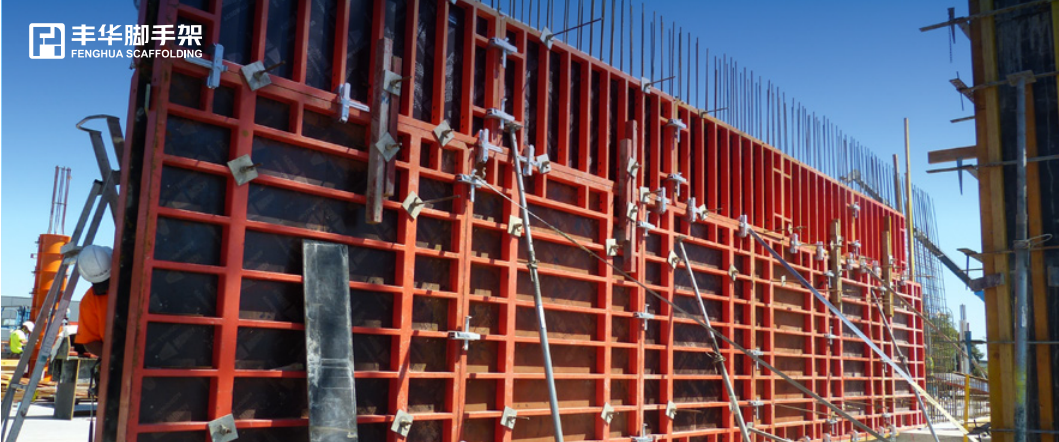
Image: RFH concrete formwork at an Australia project site, illustrating integrated walkway brackets and certified crane lifting hooks used to meet on-site safety regulations.
Request the RFH Concrete Formwork Catalogue
To compare RFH formwork panels and accessories against your project requirements, download the catalogue or contact the RFH sales team for specifications and lead times.
Have Questions or Need More Details?
Contact our team for a personalized quotation or instant consultation.
Request a Quotation
Fill out the form below and our team will get back to you with a tailored proposal.
WhatsApp Direct Chat
Prefer to chat in real-time? Message us on WhatsApp for instant assistance & quick answers.
- Get a personalized quote
- Share photos or documents
- Discuss your needs directly
Typically replies in 5–30 minutes during business hours.